
Last updated September 10, 2026
Full 25-point door and opener safety check with every visit - springs, cables, rollers, tracks, and your LiftMaster or Chamberlain opener included
You get a price before we start. It does not change when the truck arrives.
 Before
 After
After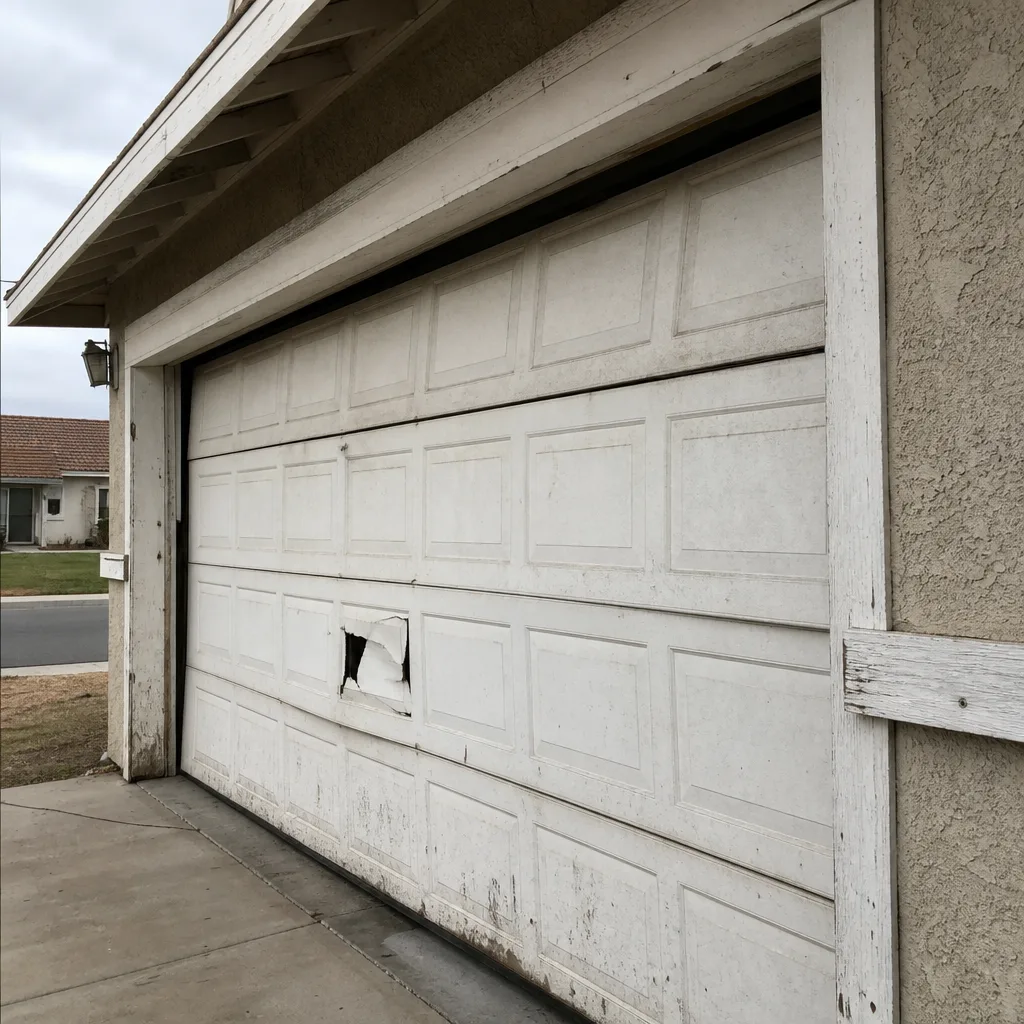 Before
 After
After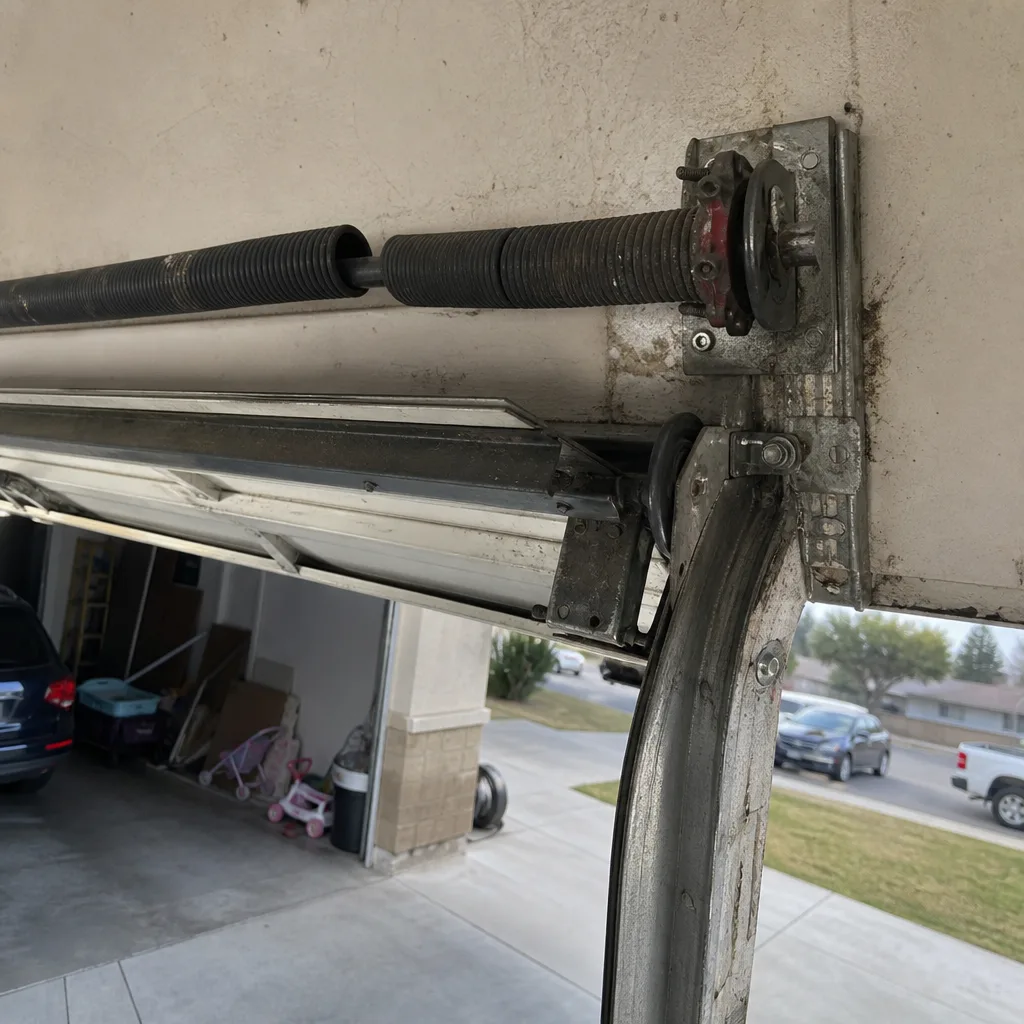 Before
 After
AfterDIY vs Professional Garage Door: The Palmdale Homeowner’s Decision Guide
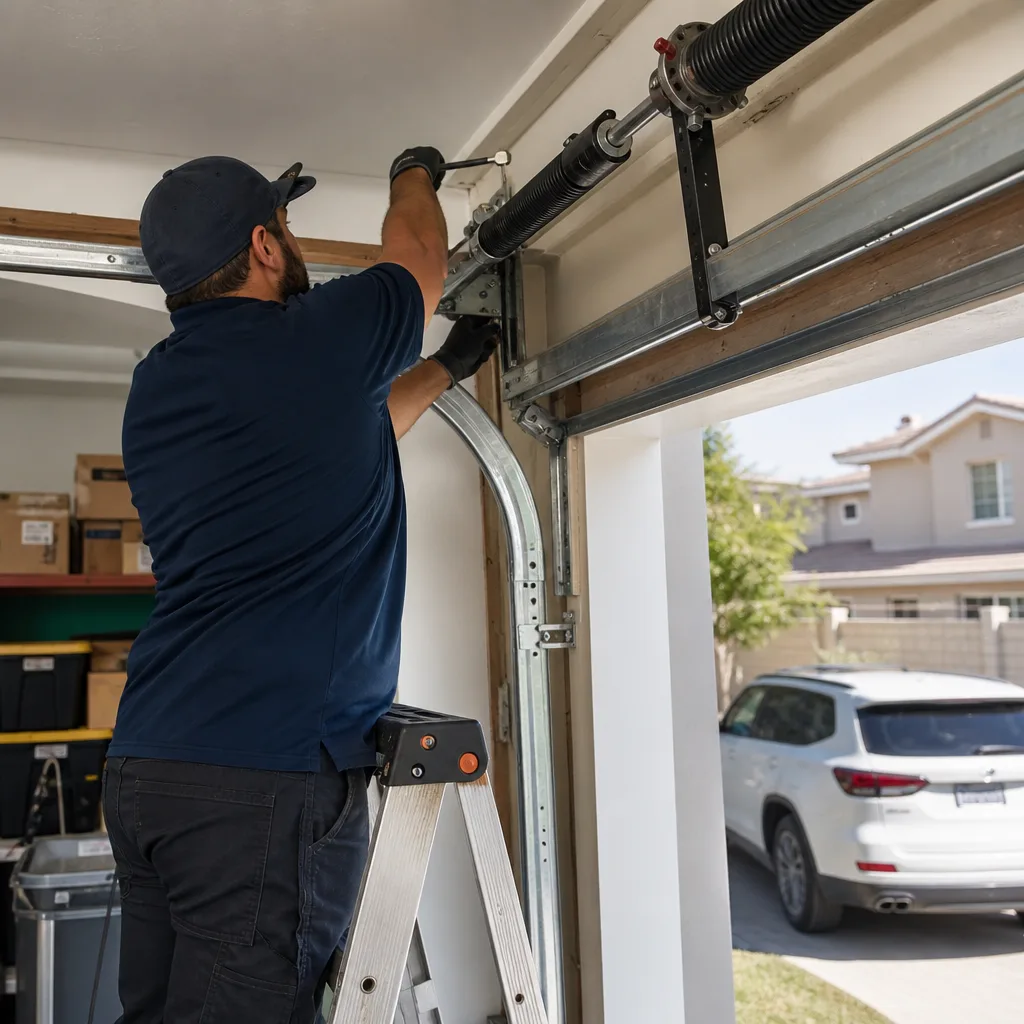
A torsion spring on a double-wide garage door stores roughly the same kinetic energy as a car moving at 35 miles per hour. That’s not a scare tactic from someone trying to sell you a service call. It’s physics, and it’s the reason the CDC lists garage doors among the leading causes of residential mechanical injury in the United States. This guide from a Palmdale garage door owner who has been under these doors since 2004 walks you through exactly which tasks belong in your hands, which ones belong in a professional’s hands, and the honest math that separates the two. For more guides & resources, see our blog.
Quick Answer
Most Palmdale homeowners can safely handle garage door maintenance like lubrication, weatherstripping, sensor alignment, and remote programming. Torsion spring replacement, cable work, track realignment, and opener motor replacement involve stored energy or weight that can kill you, and those jobs belong with a licensed professional. The line isn’t about how handy you are. It’s about whether the component stores energy, carries load, or sits at the top of a chain of failures that ends in a 200-pound door coming down on someone.
Table of Contents
- The Honest Task List: What You Can Do, What You Shouldn’t
- Palmdale-Specific DIY Considerations: Heat, UV, and Desert Weatherstripping
- Why Torsion Springs Belong in the Professional Column
- The Real Cost Math: DIY vs Professional in the Gray Zone
- Working With a Palmdale Pro as a Partial-DIY Partner
- Common Mistakes to Avoid
- When to Call a Professional
- Frequently Asked Questions
The Honest Task List: What You Can Do, What You Shouldn’t
We split every garage door job into three categories. Not two. The gray zone is where homeowners waste the most money, either by paying a pro for something simple or by breaking something that was working fine before they touched it. Here’s the list as we use it on every garage door repair in Palmdale that comes through our shop.
Category 1: Do It Yourself
These tasks require no specialized tools, no stored-energy risk, and no way to make the door dangerous if you do them carefully.
- Lubricating rollers, hinges, and springs. Use white lithium grease on metal parts and a silicone spray on nylon rollers. Do this every six months in Palmdale’s dry climate. More on that below.
- Replacing the bottom seal or weatherstripping. The Antelope Valley sun bakes rubber into brittle plastic within three to five years. This is a slide-out, slide-in job on most doors.
- Aligning photo-eye sensors. If the opener won’t close and the lights blink, check for a bumped sensor. Loosen the wing nut, aim the eyes at each other, tighten. Ten minutes.
- Programming remotes and keypads. Chamberlain, Genie, and LiftMaster all have clear programming sequences in the manual. If you don’t have the manual, it’s online by model number.
- Tightening visible bolts on the track brackets and door hinges. A socket set and ten minutes prevents the rattling that drives Palmdale homeowners crazy on windy nights.
Category 2: Watch a Video and Decide
These tasks are doable for a careful homeowner, but they carry enough risk of wasting a Saturday or making things worse that you should know what you’re getting into. We regularly get calls from homeowners who started here and ended up calling us anyway, now with a half-disassembled door.
- Replacing rollers. The top and bottom rollers, especially on a single-piece track, require you to remove the bottom bracket. That bracket is under spring tension on some setups. If you’re replacing middle rollers only, it’s straightforward.
- Replacing hinges. Middle hinges are easy. End hinges near the cables are not. Know which ones you’re touching before you unbolt anything.
- Replacing the wall button or a light fixture. Low voltage on the wall button is safe. The electrical outlet near the opener is standard 120V and demands the same respect as any household wiring.
- Installing a smart garage controller. Chamberlain’s myQ system and similar retrofit kits are genuinely plug-and-play. But compatibility with an older Genie or Craftsman opener can turn a 20-minute install into a troubleshooting session.
Category 3: Don’t Touch It
These jobs involve stored energy, support under load, or failure chains that end in a falling door. We do not care how many YouTube videos you’ve watched.
- Torsion spring replacement. The spring is wound under hundreds of pounds of torque. If it slips or breaks while you’re winding it, the winding bar becomes a projectile. People die doing this. People who do this for a living have died doing this.
- Extension spring replacement. These run along the horizontal tracks. When one breaks, it can whip through the air with enough force to fracture bone. The safety cable must be replaced properly, and the spring weight must match the door exactly.
- Cable replacement. The cables hold the door’s weight when the spring does its job. If you replace a cable wrong, the door can drop suddenly. A 16-foot door weighs between 150 and 250 pounds.
- Track realignment or replacement. The track guides the door and carries rollers at speed. A misaligned track can bind a roller and send the door off track while it’s moving. You cannot safely straighten tracks with the door in place.
- Opener motor replacement or gear-and-sprocket replacement. The opener housing contains charged capacitors that can shock you even when unplugged. And if the door isn’t balanced first, you’re putting a new opener on a door that’s already broken.
Palmdale-Specific DIY Considerations: Heat, UV, and Desert Weatherstripping
Palmdale gets an average of 280 sunny days a year, and summer temperatures regularly push past 100°F. That’s not trivia. It changes which parts wear out, which replacement products actually survive, and which tasks make sense for a homeowner in this valley versus someone in Santa Clarita or Valencia.
The Bottom Seal Problem in the High Desert
Rubber compounds that survive fine in coastal climates turn brittle and cracked in Palmdale within two or three summers. The bottom seal on a west-facing door in Rancho Vista or Anaverde can be shot in 18 months. This is the single most common DIY-friendly repair we recommend to Palmdale homeowners, and it’s one you can do yourself with a flathead screwdriver and about twenty minutes.
The catch is the product. The universal seals at the big-box stores are made of a softer rubber compound that will bake out just as fast as the one you’re replacing. We recommend a heavy-duty EPDM rubber seal rated for temperature extremes up to 140°F. It costs about twice as much as the cheap one and lasts three times as long. That’s the correct product for a desert climate, and it’s not what’s usually on the shelf at the chain stores.
Weatherstripping on the Sides and Top
UV damage hits the perimeter weatherstripping hard in Palmdale. The vinyl strips along the door edges and top crack, warp, or pull away from the jamb, letting dust and heat into the garage. This is another reasonable homeowner replacement. Pull out the old strip, press in the new one, trim to length. Make sure the strip is labeled “UV-stabilized.” Standard vinyl weatherstripping will fail again within two years in direct Antelope Valley sun.
Lubrication Frequency Changes in Dry Air
Humidity. Palmdale doesn’t really have it. That means metal-on-metal contact points dry out faster here than they do almost anywhere else in Southern California. We recommend lubricating hinges, rollers, and the spring every three months during the summer and every six months the rest of the year. If you hear squeaking, you’re already late. Squeaking means metal is grinding on metal, and that wear is permanent.
One more Palmdale-specific note: the wind. Sustained winds of 25 to 40 mph are common in the spring, and they put lateral stress on your door’s track and hinges. After a big wind event, walk outside and watch the door open and close. If you see the panels shuddering or the door hesitating at any point, the track brackets have likely loosened. That’s a Category 1 fix if the brackets are accessible and only need tightening.
Why Torsion Springs Belong in the Professional Column
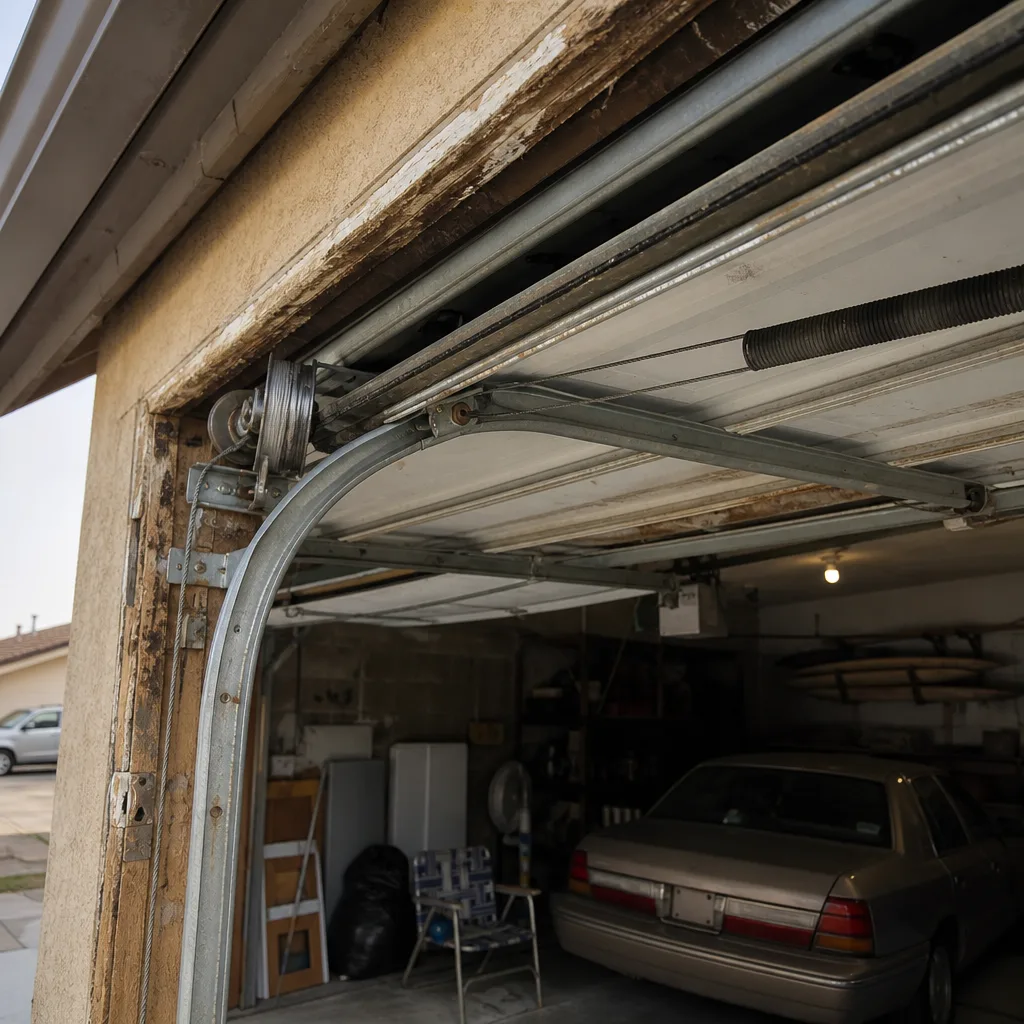
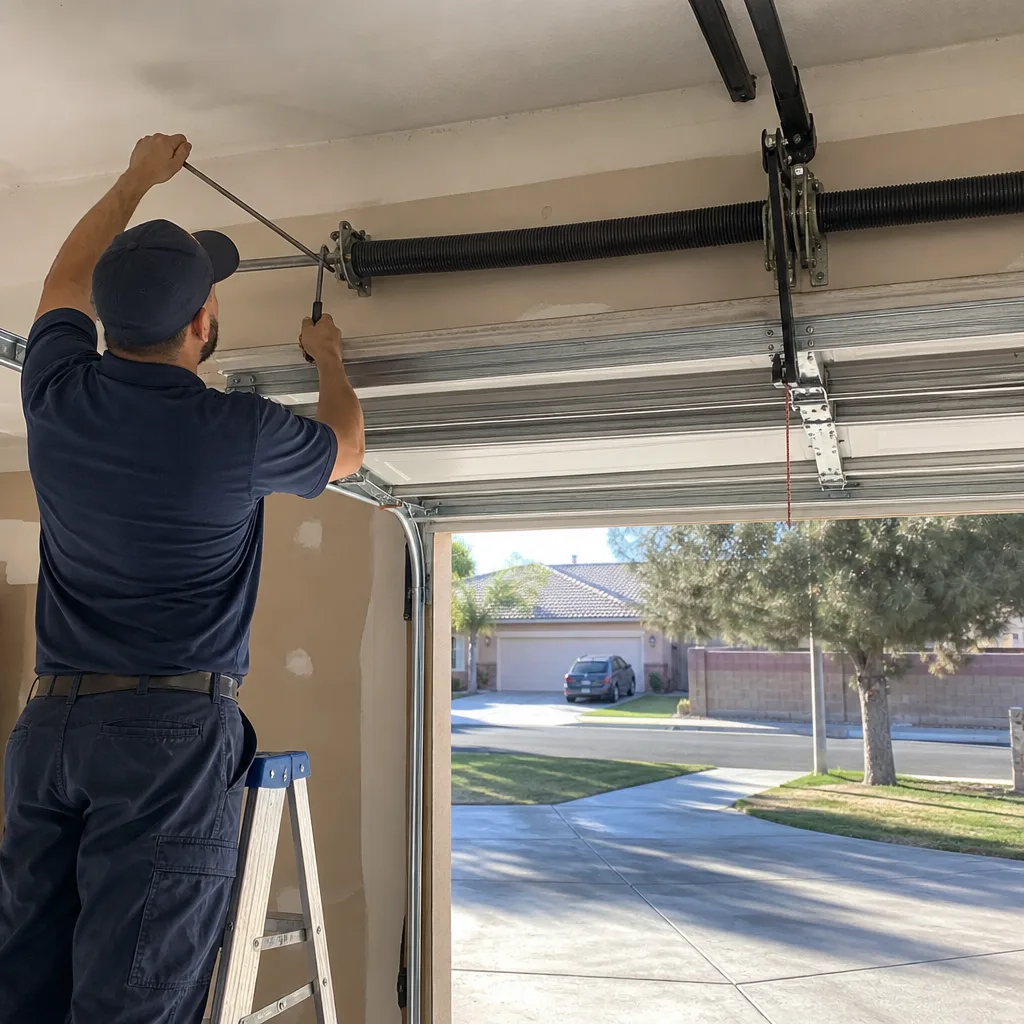
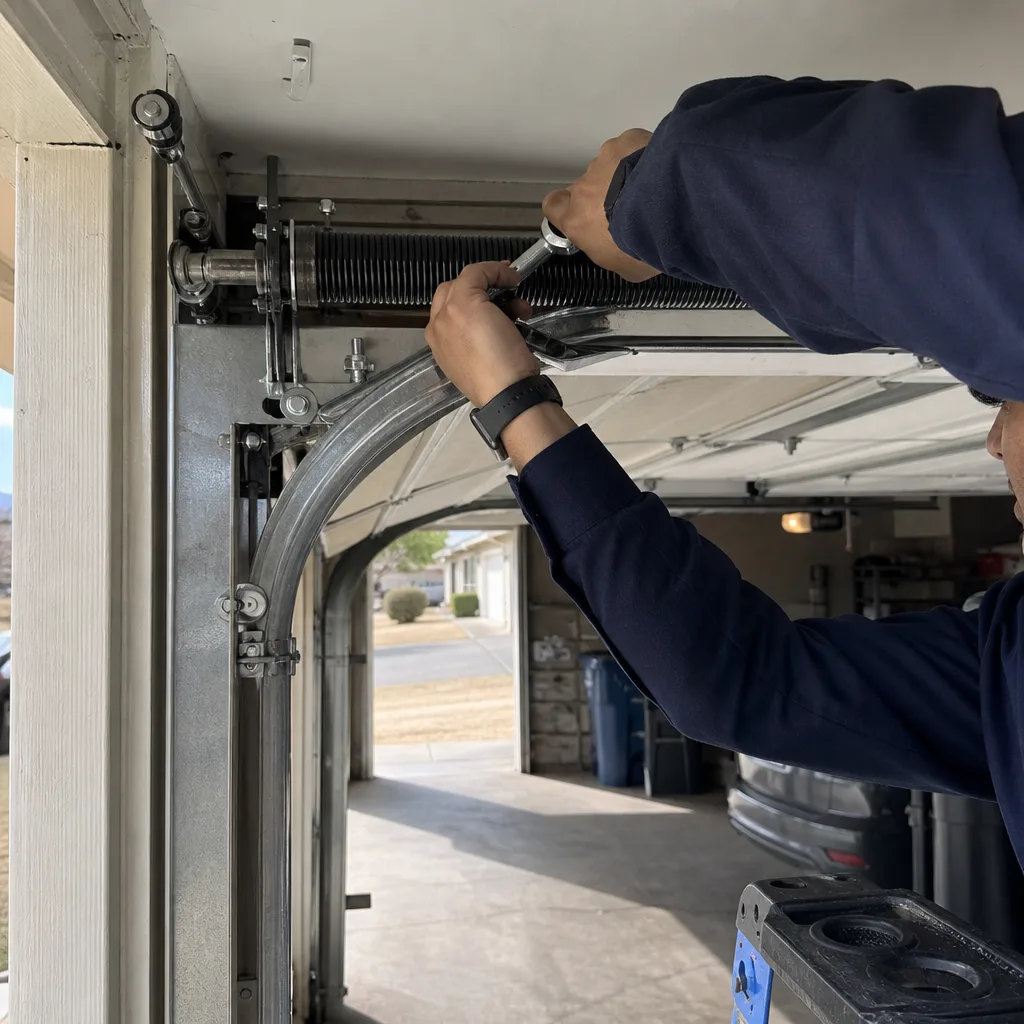
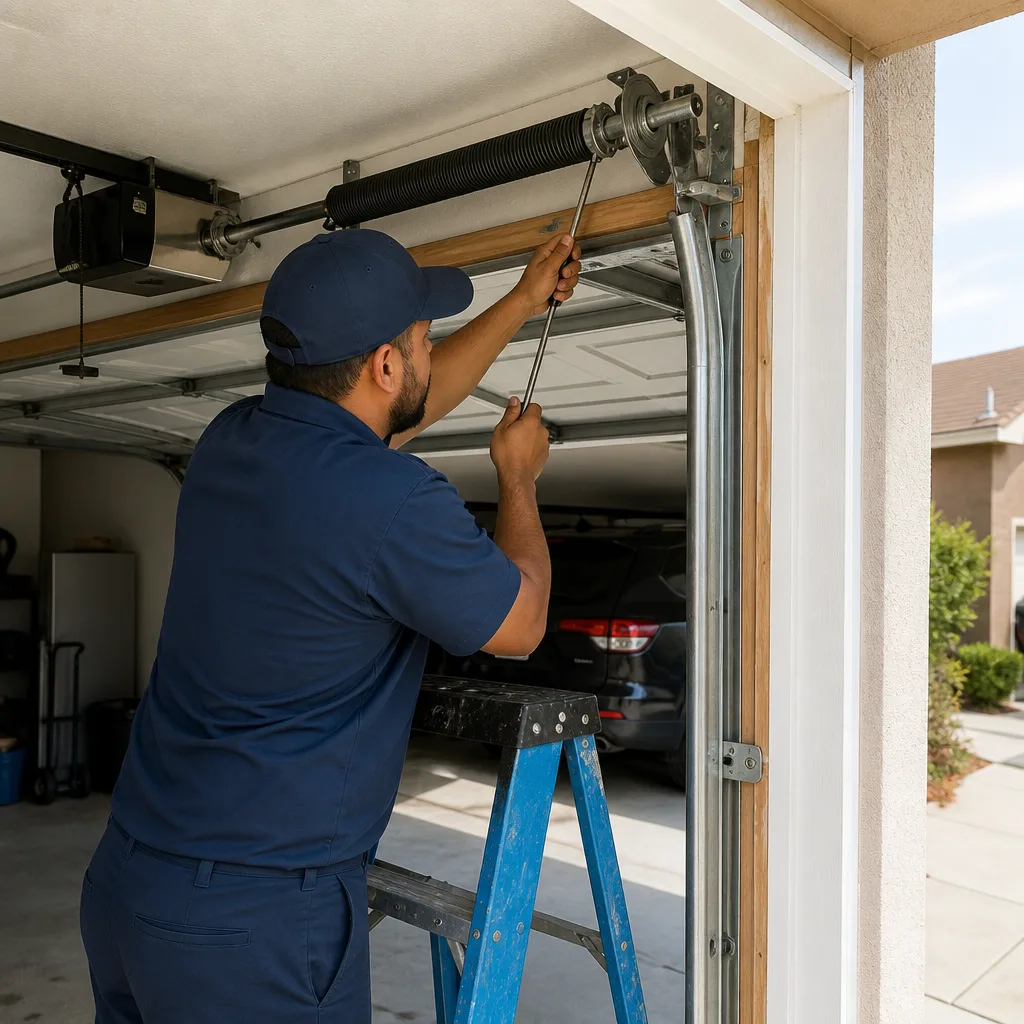
Here’s the mechanical reality, because we would rather explain it than have you learn it the hard way. A torsion spring is mounted on a horizontal shaft above the door opening. It’s wound tight to store the energy that counterbalances the door’s weight. When the door goes up, the spring unwinds and releases that energy. When the door goes down, the spring winds back up.
That spring carries hundreds of pounds of torque at rest. Not pounds of weight. Pounds of rotational force. A standard residential torsion spring is wound between 7 and 9 full turns to balance a door. Each turn adds tension. The winding cone at the end of the spring is held by two set screws that thread into a malleable aluminum casting. That’s the failure point.
Here’s what happens when a homeowner without the right tools attempts a spring replacement:
- They insert winding bars into the winding cone. These bars must be the exact diameter of the holes. Not close. Exact. A shank that’s undersized will slip inside the cone under load.
- They begin winding the new spring. Each quarter-turn requires bracing against the full load of the spring. On the ninth turn of a 250-pound-rated spring, that load is extreme.
- If the bar slips, or the cone’s set screws weren’t seated correctly, the spring releases all its stored energy at once. The bar becomes a projectile moving at speeds that have put people in emergency rooms.
- Even if the winding goes perfectly, the spring must be sized exactly to the door’s weight. A spring that’s two wire sizes off will slap the door open, slam it shut, or burn out the opener motor within weeks.
I count spring cycles the way you count tire miles. A standard spring is rated for 10,000 cycles. In Palmdale’s heat, which softens spring steel over time, you’re looking at a real-world life of 7 to 12 years for a two-car door that opens three or four times daily. When a spring breaks, you’ll hear it. It sounds like a gunshot in your garage. The door will not open, or if it’s halfway up, it will slam down.
This is the one job where we will not help you. Not because we don’t want you to save money, but because we don’t want anyone in this valley getting hurt. We have been doing this since 2004, and we still respect the spring. You should too.
The Real Cost Math: DIY vs Professional in the Gray Zone
Let’s talk dollars. Not abstract “could save” numbers. Actual prices for the Antelope Valley market, as of this writing.
Here’s what the gray-zone tasks actually cost when you do it yourself versus when you call a pro:
- Roller replacement (all rollers): DIY cost for a full set of nylon rollers runs $30 to $60 at a parts supplier. A professional replacement in Palmdale typically runs $120 to $180. But the pro job includes removing the bottom bracket safely, checking the track alignment, and warrantying the work.
- Hinge replacement (all hinges): DIY parts cost $40 to $90 depending on door height. A pro charges $150 to $250. The risk is torquing the door frame if you replace an end hinge with the door under tension.
- Photo-eye sensor replacement: DIY cost $25 to $50 for the sensor pair. A service call runs $90 to $140. This is the easiest gray-zone task, and most homeowners should do it themselves.
- Wall button replacement: DIY $15 to $35. Pro $80 to $110. Do it yourself if you can identify the wiring.
- Weatherstripping (full perimeter): DIY EPDM seal kit $40 to $80. Pro install $150 to $220. Do it yourself if you buy the right product.
Now the honest accounting of a DIY attempt that goes sideways. We get these calls regularly. The homeowner spent $60 on parts, three hours of their Saturday fighting a door that wouldn’t cooperate, and now the door is half-disassembled in the track. To fix it, a pro has to undo the partial work, do the job correctly, and sometimes replace the parts the homeowner damaged in the attempt. Total bill: the $60 for parts that are now trash, plus the full professional rate for the repair, plus any damage.
The most expensive DIY projects we see are the ones that begin as hinge or roller jobs and end as track realignments. If the door comes off its track because a roller was installed incorrectly, that’s not a $150 roller job anymore. It’s a $300 to $500 repair that includes resetting the door, checking the cables, and likely replacing the bottom bracket.
Before you start any task in the gray zone, ask yourself one question: if this goes wrong, can I safely get the door closed and call for help? If the answer is yes for the specific task you’re doing, proceed carefully. If the answer is no, call first. A free estimate costs you nothing. An emergency repair after a botched DIY job costs you time, money, and maybe a vehicle stuck in the garage overnight. For a full rundown of what to check and when, see our Garage Door Repair Maintenance Checklist for Palmdale Homeowners.
Working With a Palmdale Pro as a Partial-DIY Partner
You don’t have to pick a side. Some of our best customer relationships are with Palmdale homeowners who handle maintenance themselves and call us for the dangerous or technical work. That’s the smart way to do it, and any reputable local shop should welcome it.
Here’s how to build that relationship without the contractor getting defensive:
- Say what you’ve done, straight up. When you call, tell the person on the phone: “I replaced the bottom seal myself, and I’ve been lubricating quarterly. The issue started two weeks ago.” That tells us you know your door and we won’t waste time checking basics.
- Ask which maintenance tasks you should keep doing. A good operator will tell you what’s fine to handle and what to leave alone. We tell every customer about lubrication schedules and seal inspection. That’s the whole point of this guide.
- Request the no-charge inspection along with the repair. Any reputable shop includes a visual inspection when they’re already on-site. Ask us to note the spring cycle count, track condition, and roller wear while we’re there. That report tells you what’s coming next and what you can budget for.
- Be honest about the budget. If a full overhaul isn’t in the cards right now, say so. We would rather do a partial fix now and plan the rest for spring than see a homeowner try to stretch a failing part past its safety margin.
- Ask for the price before the work, in writing. This is the big one. Any contractor worth hiring states the price before turning a wrench and stands by that number. If someone balks at a written quote, find someone else.
Here’s a specific task list we are happy to hand off to a prepared homeowner to reduce the invoice:
- Clearing out the garage so the work area is accessible. Move cars out of the bay. Remove storage from the path of the door tracks.
- Replacing the bottom seal yourself before we arrive, if that’s part of the issue.
- Programming additional remotes after a new opener goes in. You’ll save the service charge for that add-on.
- Checking and tightening visible bolts on hinges and brackets before calling, so the call is about the real problem, not loose hardware.
The bottom line: a local shop that has been in Palmdale since 2004 values the relationship more than the upsell. Ask us anything. We’ll tell you the truth, even when the truth is “you don’t need me for this one.”
Common Mistakes to Avoid
- Spraying WD-40 on everything. WD-40 is a solvent and water displacer, not a lubricant. It will strip existing lubricant and leave metal dry. Use white lithium grease on metal parts and silicone spray on nylon rollers. This mistake is responsible for more premature roller wear in Palmdale than any other single thing we see.
- Assuming the opener is the problem when the door is heavy. An opener that’s straining, grinding, or burning out is almost always compensating for a door that’s lost its spring balance. If you replace the opener without fixing the spring, you’ll replace it again. If the opener is straining, the problem is almost never the opener.
- Using cheap big-box weatherstripping in the Antelope Valley sun. You’ll save ten dollars now and replace it again next summer. The UV-stabilized EPDM products exist for a reason.
- Replacing a spring with “the same size” without weighing the door. Spring sizing is based on door weight, not just spring dimensions. A spring that looks identical but is one wire gauge off changes the balance completely. This is the most common cause of premature spring failure we see on doors that were “fixed” by a previous homeowner.
- Loosening the wrong bolts on an end hinge. The bottom bracket bolts on many doors carry cable tension. Loosen the wrong one and the cable can whip free. This is the start of most DIY horror stories.
- Ignoring a door that shudders or hangs up at one point in the cycle. That’s not an annoyance. That’s a component failing. A roller with a flat spot, a bent track, or a failing hinge will get worse every cycle until something breaks. In Palmdale’s wind season, a pushed-in track section can turn a minor issue into an emergency.
- Skimping on the opener’s manual release test. Once a month, pull the red handle and lift the door by hand. If it’s heavy, the spring is failing. That five-minute check catches problems before they strand you with a car stuck inside at 9 p.m.
When to Call a Professional
Call when the spring breaks. You’ll know it when you hear it. Call when a cable is frayed, when the door is off its track, or when the opener motor is dead and the door won’t move manually either. Call if you’ve already started a repair and the door is now stuck halfway or leaning. And call when you look at the door and feel that pit in your stomach that says something isn’t right. That feeling exists for a reason.
Otto’s Garage Door offers free estimates in Palmdale. The number is (661) 605-7159. We answer the phone ourselves, we quote the job before we show up, and the price doesn’t change at the door. If the job isn’t right, the 90-Day Done Right Promise says we make it right. One call to the owner. No runaround.
Frequently Asked Questions
Torsion spring replacement in Palmdale typically runs $250 to $400 for a standard double-wide door, including the springs and labor. Extension springs run a bit less, usually $180 to $300. The price depends on the door’s weight, the spring cycle rating, and whether the job is done during normal hours or as an emergency call. Call (661) 605-7159 for an exact quote on your door. Estimates are free.
No. The winding process requires specialized bars, exact spring sizing, and experience managing hundreds of pounds of stored torque. A mistake during winding can send a steel bar through you or a wall. Even professionals treat spring replacement as the highest-risk job in the trade. The cost of a professional replacement is a fraction of an emergency room visit.
The dry Antelope Valley air strips lubricant from metal contact points faster than humid climates do. In Palmdale, metal-on-metal parts like steel rollers and hinges need fresh lubrication every three months during summer and every six months the rest of the year. Squeaking means the existing lubricant is gone and the metal is wearing. Lubricate now.
It depends on the door’s condition and what’s failing. A 15-year-old door with a good panel and track system can be worth spring and roller replacement, which extends its life another 5 to 8 years. If the panels are rusting, delaminating, or the track is bent, the smarter money often goes toward a new door. For a straight recommendation, call us. We’ll inspect it and tell you what we’d do if it were our house.
This one sits in the gray zone. A direct replacement of an existing opener with the same model family is doable for a careful homeowner with a helper. But the job requires checking the door balance first, mounting the rail level, and adjusting the force and travel limits correctly. If the door isn’t balanced, the opener will work too hard and fail early. If you decide to do it, check the door balance by hand first. If the door is heavy, fix that before touching the opener.
It shouldn’t. We quote the job on the phone and hold that price at the door. If a written estimate changes significantly during the visit, it means the original quote was based on incomplete information. Demand a clear explanation of what changed, and if you’re not satisfied, get a second opinion. Otto’s Garage Door offers a free second opinion on any written estimate inside our home county. No trip charge.
The Bottom Line
A garage door is a 200-pound panel riding on two springs. Respect it. The tasks you can safely handle in Palmdale are lubrication, weatherstripping, sensor alignment, and remote programming. The tasks you should not touch are springs, cables, tracks, and opener internals. In between, there’s a gray zone where the right answer depends on your tools, your time, and your tolerance for risk. The honest thing is this: a good local shop will tell you when you don’t need them. And when you do need them, the name on the van should be the name on the invoice and the name on the license. That’s how we’ve run things in Palmdale since 2004, and it’s why the neighbors still call.
Call Otto’s Garage Door at (661) 605-7159 for a free estimate on any repair, replacement, or question about your door. We answer the phone ourselves, quote the price before we show up, and back every job with the 90-Day Done Right Promise in writing. The name on the van is the name on the invoice. Ask anyone in Palmdale.
Written by Otto Reinhardt, Owner at Otto’s Garage Door, serving Palmdale since 2004.